
01 · Storyline 360
Spot the Phish
A branching cybersecurity scenario that asks employees to inspect a suspicious message, verify its claims, and choose a safe reporting response.
Instructional design · learning and development
I translate complex processes into clear, usable instruction through scenario-based e-learning, microlearning, assessment, and purposeful feedback.
Selected work
Each independent portfolio project starts with a workplace decision and uses interaction, practice, and feedback to make the expected behavior clear.
01 · Storyline 360
A branching cybersecurity scenario that asks employees to inspect a suspicious message, verify its claims, and choose a safe reporting response.
02 · Rise 360
A responsive microlearning course that helps employees turn vague comments into clear, actionable feedback using the Situation-Behavior-Impact framework.
03 · Storyline 360
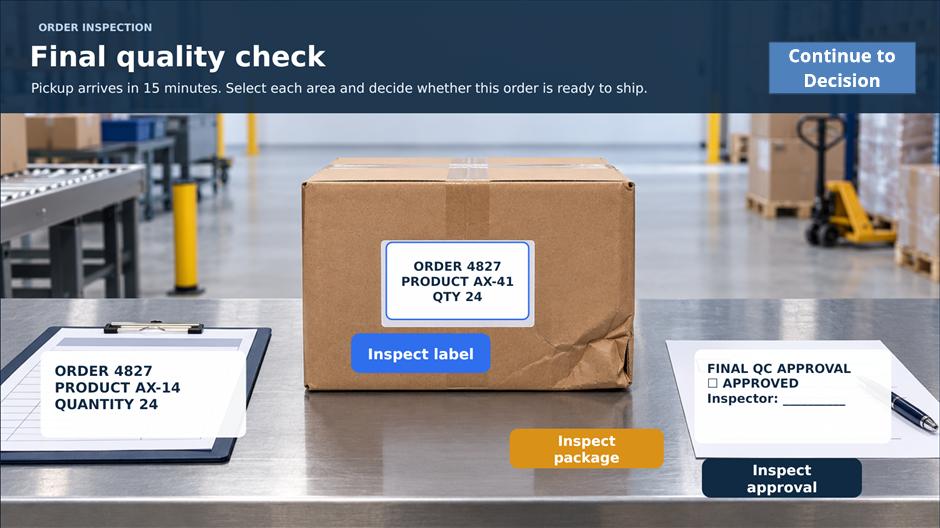
A decision-based quality assurance interaction that asks learners to inspect an order and determine whether it is ready for shipment.
Case studies
Security awareness · 5–7 minutes
A safe practice environment for recognizing manipulation, investigating details, and reporting a suspicious message.
Launch projectSecurity guidance is easy to recognize after the answer is revealed. The harder performance is slowing down under pressure, inspecting the right details, and choosing a safe response.
I built a branching scenario around a simulated payroll message. Learners examine four clues, receive consequence-based feedback, and cannot advance until they have completed the inspection.
The project uses slide layers, triggers, true/false variables, and conditional navigation. I tested the interaction with keyboard controls and treated it as an accessibility-aware prototype.
I first mapped and tested the decision flow in a clickable prototype, gathered outside feedback, then rebuilt the experience in Storyline and published Web and SCORM 1.2 versions.
Workplace communication · microlearning
A concise, responsive lesson that gives employees a repeatable structure for useful feedback.
Launch projectFeedback often fails because it is too broad, personal, or disconnected from a next step. Learners need a structure they can recall in the moment.
The course introduces the Situation-Behavior-Impact framework, contrasts weak and strong examples, and moves quickly into guided practice.
Short content blocks, a process sequence, applied examples, and multiple-choice questions create a focused experience that works on desktop and mobile screens.
I used Rise 360 to prioritize readability, pacing, and responsive delivery, then produced Web and SCORM 1.2 packages for portfolio and LMS use.
Operations · quality assurance
A compact operational scenario focused on inspection, judgment, and the consequences of a shipping decision.
Launch projectA checklist can state the standard, but it does not show whether a learner can apply that standard when an order contains competing signals.
Learners inspect the package, label, and approval record before deciding whether the order should ship. Immediate feedback connects the decision to operational risk.
Storyline triggers and feedback layers keep the experience direct: inspect, decide, see the consequence, and try again when needed.
I designed the interaction as a reusable pattern for operations training and published Web and SCORM 1.2 versions.
My approach
I start with what a learner should be able to notice, decide, explain, or do. Content earns its place by helping that performance—not by filling a screen.
Define the observable behavior, constraints, and consequences.
Map the smallest sequence that lets a learner practice meaningfully.
Explain why a choice works and what the learner should do next.
Check navigation, conditions, readability, keyboard use, and publishing.
Experience
My instructional-design work builds on more than a decade of curriculum development, facilitation, assessment, coaching, and cross-cultural program leadership.
2024–Present
Rawlinson Middle School · Northside ISD
Design and facilitate sequenced learning for 100+ participants, create learner and facilitator resources, evaluate performance, and lead multi-stakeholder programs.
2019–2023
Helena Academy of Dramatic Expression
Designed course sequences, instructor materials, scripts, assessments, and learning-intensive productions for varied ages and proficiency levels.
2013–2019
Royal Kindergarten Education Company
Created standardized curriculum and classroom resources while training and coaching approximately ten international educators.
Contact
I am based in San Antonio, Texas, and interested in instructional design, learning and development, and training-content opportunities.